Most of the card games on this site belong to one family, and knowing its single rule makes all of them immediately playable.
The rule
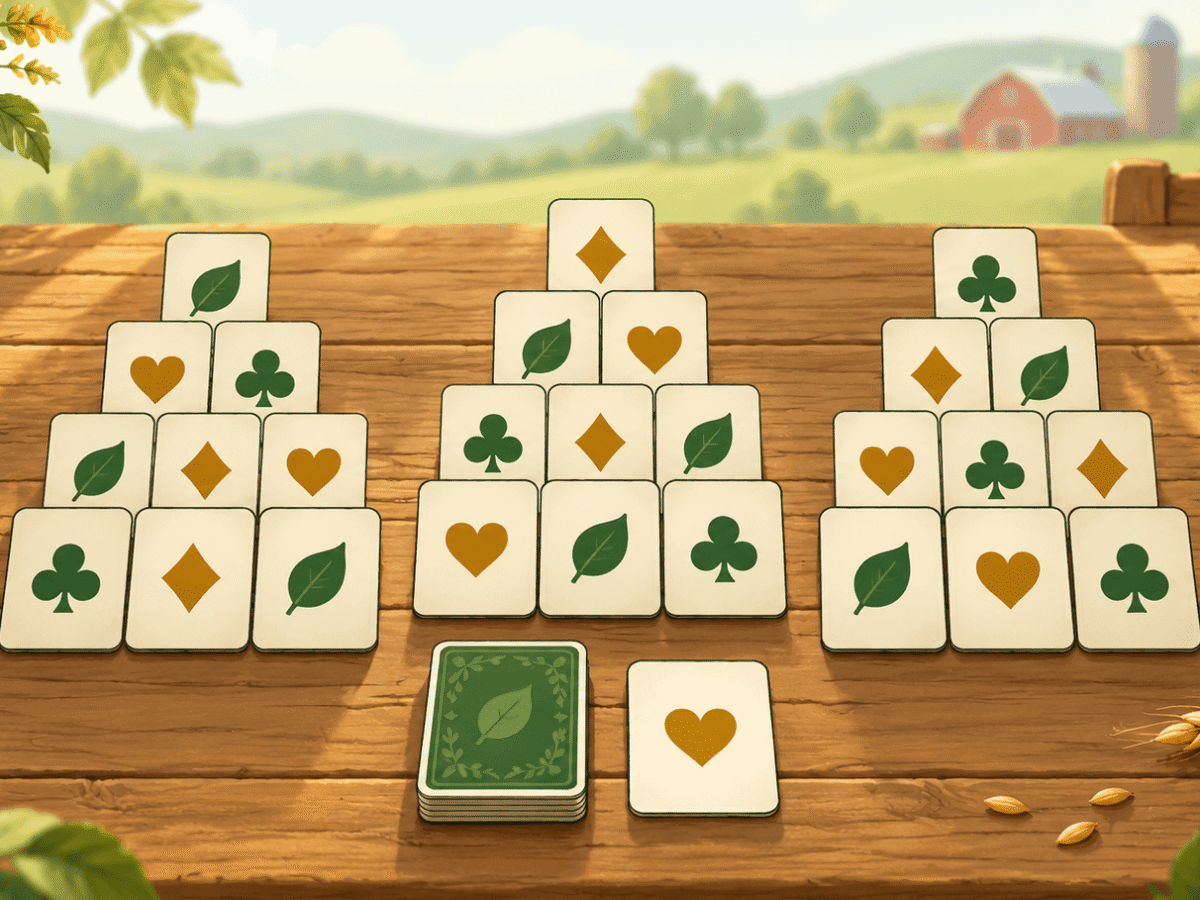
Cards are dealt in overlapping peaks. One card sits face-up on the waste pile. You may take any exposed card from the peaks whose rank is exactly one above or one below that face-up card — and that card then becomes the new reference.
Suits are irrelevant. Colour is irrelevant. Only the number matters, and it works in both directions: on a seven you may take a six or an eight.
Aces wrap
The detail that catches people out is that the sequence is circular. An ace can be taken on a king and a king on an ace, which means a board that looks stuck often is not. Beginners who miss this draw from the stock far more often than they need to.
Why it is not Klondike
Klondike — the solitaire that ships with most computers — is about building suited foundations and freeing columns. TriPeaks has no foundations and no columns. You are dismantling a fixed shape, and the only resource is how many cards remain in the stock.
That makes it faster, more forgiving and considerably less likely to become unwinnable through an early mistake.
How to play it better
Two habits are worth more than anything else. Chain as far as you can before drawing, because every draw spends a resource you cannot get back. And when two moves are available, take the one that exposes a face-down card rather than the one that scores more — turning cards over is what keeps a deal alive.
Where to try it
The Seasons series is the deepest example on this site, running to five entries with thousands of deals between them. Solitaire TriPeaks Harvest is the one to start with if you would rather have varied board shapes than sheer volume.
Games mentioned in this article
- Solitaire Farm: Seasons — filed under Farm Solitaire & Card Games
- Sheep Farm — filed under Farm Animal Games
- Farming Simulator 2 — filed under Farm Simulation Games
- Farm Triple Match — filed under Farm Solitaire & Card Games
- Farmer Challenge Party — filed under Realistic Farm Games
- Paradise Island 2 — filed under Farm Simulation Games