Idle games look like they play themselves. They do not — they play themselves badly unless you make three or four decisions correctly, and those decisions are the whole game.
Rate beats capacity, almost always
Every idle economy offers two kinds of upgrade: something that produces faster and something that holds more. Rate compounds every minute afterwards. Capacity only pays if you were away long enough to fill it and come back to find production stopped.
If you are actively playing, buy rate. If you genuinely close the tab for hours, capacity earns its place — but not before.
Find the bottleneck before you spend
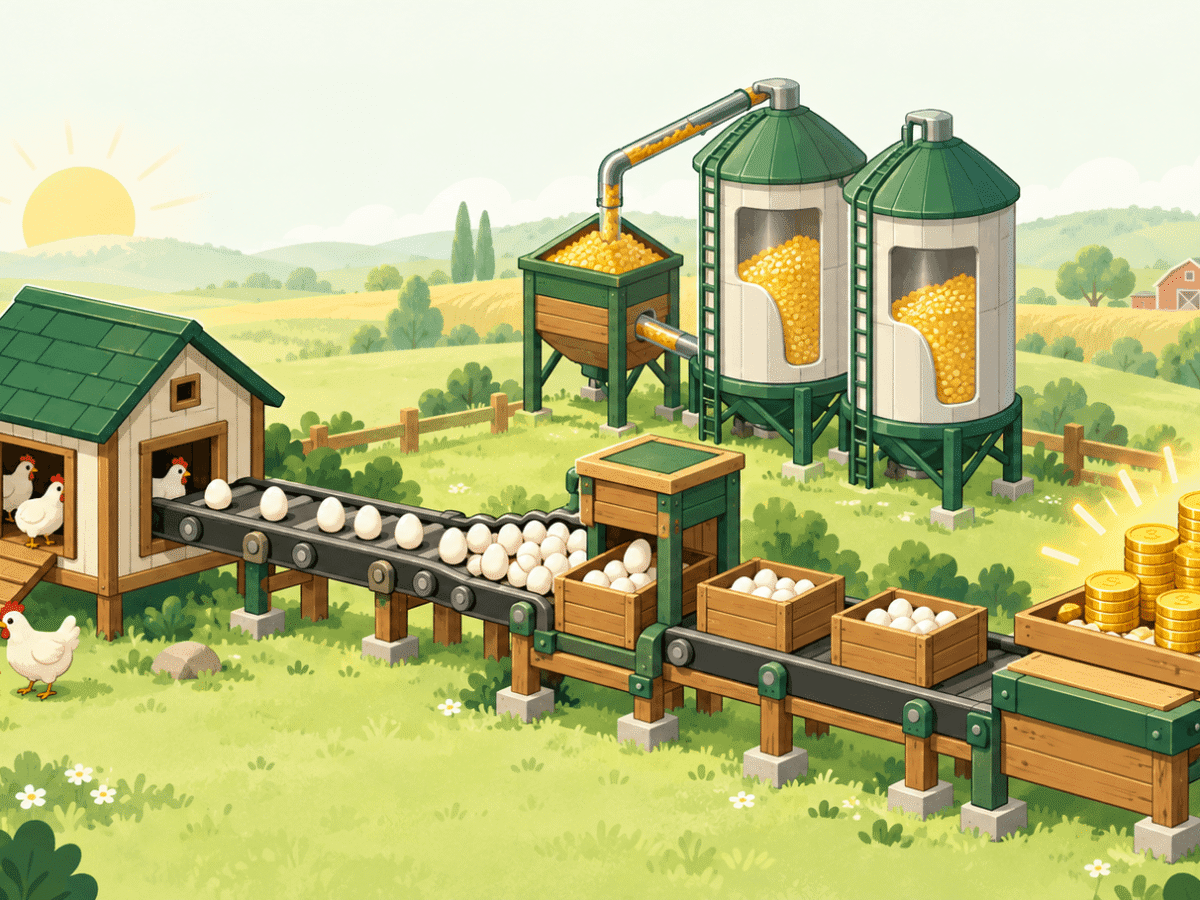
The most common mistake is buying more production while output sits waiting to be processed or stored. If a queue has formed anywhere in your chain, more input makes the queue longer and your income identical.
The queue is the signal. Spend where the backlog is, not where the upgrade is cheapest.
Boosts are multipliers, so timing is money
Games that offer weather boosts, sunshine or double-output windows are multiplying your current rate. Triggering one early, when your rate is low, wastes most of it. The same boost after two upgrades can be worth several times more.
The habit worth building: never trigger a boost immediately before an upgrade you can already afford.
Automation over expansion
Where a game lets you hire workers, hire them. Every step you still perform by hand is a ceiling on the entire operation, and buying more land simply makes that ceiling more expensive to hit.
When to stop
Idle games do not end, so the useful question is when a session has stopped producing decisions. Once every upgrade costs more than several minutes of income and none of them unblock anything, the interesting part is over until you come back later — which is exactly what the format is designed for.
Games mentioned in this article
- Solitaire Farm: Seasons — filed under Farm Solitaire & Card Games
- Sheep Farm — filed under Farm Animal Games
- Farming Simulator 2 — filed under Farm Simulation Games
- Farm Triple Match — filed under Farm Solitaire & Card Games
- Farmer Challenge Party — filed under Realistic Farm Games
- Paradise Island 2 — filed under Farm Simulation Games